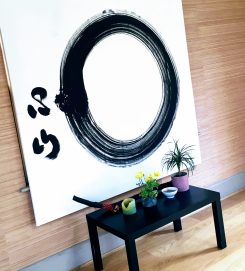
This is the transcript of a talk I gave for the Zenways Sangha in October 2023
In Zen we say that “to study Zen is to study the self; to study the self is to forget the self; to forget the self is to actualize all things”.
I find that this quote by Zen Master Dogen really embodies so much of our practice and this evening I would like to talk a little bit about that.
To study Zen is to study the self, this is the first part of the quote, how do we study the self? I think that our practice explores this in many different ways but perhaps the most penetrating way is by exploring the koan or the question “Who am I?”. When we pause for a moment and we honestly open to explore this question, we ignite a process which can trigger some indisputable insights.
Very recently, I spent 2 weeks in Italy where I was born and where I grew up. There, as I was tidying things up in the house I grew up, I went through some very old pictures of my late parents and of myself. It came very natural to me asking myself where was that little boy I was seeing in the picture. Of course, there is a thread of memories and events which keep a sense of continuity between the boy in the picture and the person you see in the screen now. However, that is not the whole story and that is where “study the self” begins.
So, when we pause for a moment, when we offer ourselves the opportunity to simply rest in this investigation with as much openness and honesty as we possibly can, it seems to me that we are igniting a process of perspective-shifting which can lead to some very helpful insights.
Of course, as I was saying, memories, ideas, events seem to keep this solid and fixed sense of me together, it seems that it all makes total sense. At one point in time, this little tiny body was born, he grew up in a family that fed him with food but also with an education, traditions, culture, things to like and things to dislike. Now, this little boy has grown and seemingly still carries traits of that, no doubts about that. I still acts in ways I learned back then, I still have preferences which stem from my parents’ education, I still resist certain situations as a habitual reaction that I developed in my youth. All these elements seem to have crystalizedand have become “me”. However, is that so? Is that how things really are? Who am I really?
The Buddha talked about the aggregates or Skandhas in Sanskrit language. What are these skandhas? Well, according to the Buddha, people are made of five aggregates, or skandhas or “heaps.” They are referred to as heaps because they’re collections of parts which don’t have any central core, any fixed centre, there is not a fixed centre, entity, self, there is not a fixed me. There are 5 skandhas and these are: form, our physical body. Feeling, the sensations we experience in our body. Perception, what we experience through our sense organs, light, smell, taste, touch, etc. Mental formations, all our concepts and thoughts and ideas. And finally, consciousness, our being aware of all these things just mentioned.
All these elements seem to give us a fixed sense of self, the same body I saw in the picture is the same body I have now, just a little bit bigger. I still feel good when someone tells me I am a strong cyclist and not feeling that good when someone tells me I am not that good after all, I still love the smell of roses and I am still in awe of the Italian Alps. This is what I believe to be me, this is how I think things are! Mmmmmh!
It is worth examining all these elements in us, again, with openness and honestly since with reflection and practice, we can begin to understand that all of these are fleeting and as anything else, these five skandhas (form, feelings, perceptions, mental formations and consciousness) are subject to change and decay. In a way, our practice is to be at peace with this fact as this leads us straight to be free from suffering. We cannot hold on to anything. Body, feelings, mental formations and so on are just flowing processes among other flowing processes. I would recommend to get hold of an old picture of yourself and simply investigate, simply be open to study the self in that way.
So, to study the self is to forget the self. This is the second part of the quote. How can we forget the self? Are we not carrying it wherever and whenever we are? That is an interesting one and I believe it can be approached in different ways which I am sure are all equally valid.
To me, forgetting the self is simply doing what seems to be necessary without ifs or buts. When we are able to forget all those elements which we believe are forming our fixed self, we are simply able to engage fully with the requirements of the moment. It is no longer Riccardo pulling the weeds in his garden which, by the way, I don’t like but how I see it, pulling the weeds just happen. Simply merging into what the present moment requires by dropping all the ideas about it. Simply becoming, embodying the action. In that way, I forget the self and I can explore and investigate another dimension of our study. Who is pulling the weeds if Riccardo is not doing it? Even this part of the quote is worth investigating, next time you are doing something around the house, simply, intuitively engage with the action without any particular ideas about it. Forget yourself as the doer of the action and explore the possibility of the action simply happening.
We are now at the end of our quote, to forget the self is to actualize all things. So, when we look clearly and honestly at ourselves, we begin to dissolve those boundaries that seem to separate us from other people and other things. We can start simply acting as it seems fit in the very present moment of things, we align totally, with no resistance, physically and mentally to the arising of this one moment, one thing which is all things. To forget the self is to actualize all things, it is to simply arise with all things.
Of course, there is still a “me” that wants to take responsibility for my actions, my words, my job and so on. I still need to take decisions and what seems to be the best thing to do, the best thing to say. Nobody can do that for me. I am not separate from all things, I couldn’t be even I try my hardest, and still I know that things won’t be done or said unless I choose to do or say them. How can we live a life without suffering within this seemingly paradox? A couple of weeks ago I facilitated a short event where we explored this alignment, where us, the individual, the entity that might seem separate wants to simply flow with all things, in harmony.
We called it “not one, not two”. Not sticking with the idea that “I don’t need to do anything, the universe will take care of things”. And, not sticking with this idea of “me as a separate entity from all things, me having to fight against all things”. In other words, not sticking with anything at all but simply flowing with whatever reality we happen to live. How can we comfortably relax and simply flow into this seemingly paradox? How can we explore this possibility of not getting stuck with anything at all. Not getting stuck in this absolute idea of oneness and not getting stuck in this place of separation, of me against the rest of the universe. Where is this place? How can we find it? What are the benefits of this alignment?
We are now going to do some walking and sitting meditation, perhaps it is going to be a good opportunity to start this exploration. Exploring the possibility of resting in the not knowing, simply dropping all ideas and all the thinking. Forgetting the self to actualise all things. Thanks for listening and enjoy the exploration!
 Zen Mindfulness Cambridge Zenways Italia