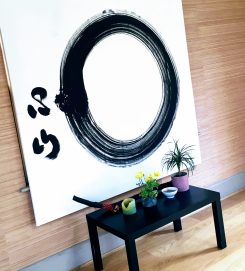
This is a summary of my Dharma talk on “Why Did Bodhidharma Come from the West?”
I’ve recently become a little bit “obsessed” with studying and practicing with koans—sitting with them, taking them with me on bike rides, and bringing them into any activity that allows space for them. I try to stay curious and open to how they work on me, or through me.
Today, I’d like to explore a question that appears in two of the forty-eight koans in the Mumonkan:
“What is the meaning of Bodhidharma coming from the West?”
At first glance, it sounds like a historical question—maybe just a curiosity. But Zen isn’t about history. It’s about this moment. Even though we refer to many teachers of the past—and I’m doing so tonight—we’re not honoring them for their biographies, but because their teachings still echo in the present. So, for me, this question isn’t really about history.
Let’s begin with the figure himself: Bodhidharma.
Bodhidharma was an Indian monk, traditionally considered the one who brought the Zen teachings to China, sometime around the 5th or 6th century. One story says that when he met the Chinese Emperor, he was asked:
“What is the first principle of the holy teachings?”
Bodhidharma replied,
“Vast emptiness. Nothing holy.”
The Emperor, surprised, asked,
“Who is it that stands before me?”
Bodhidharma answered,
“I don’t know.”
That’s how Zen entered China—not with flattery or doctrinal clarity, but with something stark, raw, real. If Bodhidharma came to win friends or followers, he probably didn’t succeed immediately. But I doubt that was his concern. His concern, I imagine, was how to share his realization. Not through ideas or systems, but through direct experience.
That same attitude—the refusal to let us grasp at concepts—is found throughout the Mumonkan, or The Gateless Gate. The koans don’t aim to teach us something, but to unteach us. They ask us to drop what filters reality, to let go of the mental scaffolding that keeps us from what’s right here.
Let’s look at Case 5, titled “Kyōgen’s Man Up a Tree.”
Kyōgen said:
“It’s like a man up a tree, hanging from a branch by his mouth.
His hands can’t grasp a bough, his feet can’t touch the trunk.
Another man comes and asks from below,
‘What is the meaning of Bodhidharma’s coming from the West?’
If he doesn’t answer, he evades his duty.
If he answers, he falls and dies.
What must he do?”
Now that’s a trap, and a paradox. Of all the questions to ask a man in such a predicament!
Hanging by his mouth—if he opens it, he falls. But if he stays silent, he’s accused of failing to respond. There’s no safe option. He’s being asked to express the inexpressible, not later, not in theory, but right then—in the most inconvenient, high-stakes moment.
This isn’t about logic. It’s about immediacy. The man has no time to prepare a clever reply. What can he do?
But of course, the real question isn’t about the man. It’s about us. What do we do when life demands our full response—when we’re under pressure, with no space to hide behind intellect or spiritual platitudes?
We don’t know what the man did. The koan leaves it open. The practice is: what would we do?
Zen doesn’t give us answers. It doesn’t tell us what to do. It corners us. It asks: In the immediacy of this moment, what happens when you drop what you know?
Now, let’s look at Case 37, a much shorter but no less striking exchange.
A monk asked Jōshū,
“What is the meaning of Bodhidharma’s coming to China?”
Jōshū replied,
“The oak tree in the garden.”
Unlike the man hanging in the tree, Jōshū can give an answer. And he does. But did he actually answer the question?
He could’ve launched into an explanation about Bodhidharma, his teachings, or his journey. He could’ve made it philosophical, spiritual, historical. Instead, he just says:
“The oak tree in the garden.”
That’s it. No metaphors, no symbols, no doctrine. Just what’s right there, right then. It’s incredibly ordinary—and yet, I find it deeply profound.
To me, he’s not suggesting the tree means something. He’s pointing to a reality that doesn’t represent anything. It just is.
These two cases—one man suspended in the air, one tree rooted in the ground—both bring us back to the same question:
Why did Bodhidharma come from the West?
Or maybe—did he come from the West? Does it matter?
Maybe he didn’t. Maybe there was no West, no East, no “coming.” But again, that’s not the point. The question, like the koans themselves, is meant to wake us up. Not to some hidden truth out there, but to this, right here—this body, this breath, this moment.
So what are we being invited to do?
To enter this moment fully. To respond to life 100%. Even when we feel like we’re hanging from a tree, even when we’re being asked to speak but it feels impossible.
Case 5 tells us that if the man doesn’t answer, he fails his duty. But what is that duty, really?
I don’t think it’s about giving an answer. I think it’s about responding—being present. That’s enough.
And maybe Jōshū pointed to the oak tree because that’s where he saw Bodhidharma—not as a person from history, but as this breath, this leaf, this presence.
We all have moments when we feel suspended—when we’re asked to act or decide, with no guarantee of the outcome (which we never have). That’s where the koan is pointing—not to something ancient, but to something alive.
It sounds simple, but it’s not easy. And that’s why I find koan practice so effective. Old habits, deep patterns—they keep creeping in. But every time I return to the koan, I’m reminded:
Just drop the question. Drop the doubt. Do what needs doing—do it fully.
We love answers. We love maps. We want to know what Zen means.
But Zen isn’t something we know.
It’s something we are.
Something we do.
Even before we know it.
Thanks for listening.
 Zen Mindfulness Cambridge Zenways Italia