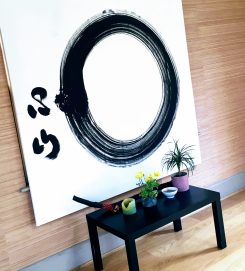
This is the transcript of a talk I gave to the Zenways Sangha in December 2023
A few weeks ago, I run a 2 evenings event in which I talked about using our everyday life, our home, work, family, all kind of everyday activities as our Zen practice.
I had just come back from the Sesshin and comparing the well scheduled time spent in the retreat with the less scheduled experience of family/work life was something that arose very naturally. During a retreat everything is designed to allow people to simply focus on their practice; a schedule, meals are ready, activities are all planned, all follows a precise order.
Then we go back home and things are not exactly the same, things can happen unexpectedly, meals need to be made, we need to speak to people, we need to listen to people, we need to take responsibilities and carrying out various tasks. Well, that is at least my usual everyday life but, as I was saying that evening, I truly think that this is the best possible arena for our own practice.
We can and we want to use our everyday life as an ongoing retreat, moment to moment, situation after situation. Our practice is a practice to be used, there is nothing to understand in a way and for Zen practitioners, there is no time in which we are not practising. Life and practice are exactly the same thing, no duality, no separation.
In the second Noble Truth the Buddha says that we suffer because we want things different than they are. I can only guess here but, at times during our everyday life at home we are confronted by things which we would love to be different and, these things can trigger our suffering, our dissatisfaction, first Noble Truth, life is suffering. So, how do we end this suffering? The Buddha says that we can end suffering and he gave us the 8 Noble Truths as the way to do it.
So, we have our home life and what we want to do is to simply continue with our responsibilities, with our jobs, with our tasks, our interactions with other people but, we are going to treat each of these situations as an opportunity to see through our resistances, to see through things that make us suffer. So, we practice right actions, how does a right action look like? We practice right speech, how do I communicate to other people? We practice, right mindfulness. Where is my attention when I am engaged in some tasks? And so on and so forth, we have an endless number of opportunities and we can develop a more fluid way to engage with our life experience, again, engaging with all we do, noticing where our resistances are, understand these resistances and see right through them….
What do I mean by seeing right through them? Seeing that all kind of resistances we might perceive don’t really have a fundamental truth to them. Many times, we might react to them as they do have something fundamentally true in them, which, of course, becomes the source of our suffering. Taking each opportunity to deepen our practice towards liberation, towards real freedom from suffering. ….and that, it is going to benefit us but also very importantly it is going to benefit, perhaps unknowingly all those people we get to touch in our everyday life.
During the 2-evening event, we talked about the importance of Nari Kiru when engaging with anything we do. For me the very essence of Zen practice. What is Nari Kiru and how do we do it when we engage with daily tasks? Our days are surely composed by different moments, tasks, interactions and all of them are equally important, including relaxing, having a good time, enjoying a movie, a meal, anything really. We don’t want to dismiss anything from our intention to practice, to live fully, wholeheartedly. We want to embody everything 100%. Going for a walk, a run, a cycle ride. Walking our dogs, cooking, listening to music, eating, chores around the house….. Nari kiru (become cut off).
Nari kiru is a phrase that I am sure you have heard a few times from Daizan. “Nari” means “to become”, and “Kiru” means “cut off”. To become cut off from all of the other things which might distract us and just 100% be what we’re doing. Tasks like cooking, like hoovering, like typing, like listening. Nari Kiru, to become cut off, when cooking, just cooking. When eating the food, just 100% eating the food. Nothing else. When hoovering, simply become hoovering, be one thing with the hoover, leaving no room for thinking about other things but simply embody our actions.
We are simply cutting off all idle dualistic thinking and fully participate, wholeheartedly with each moment of our life and we help our practice to become stronger.
Many times, we might act half-heartedly. We might be hoovering whilst thinking about what to have for our Christmas dinner. There is a split there. The body is doing something in the present, the mind is busy doing something else. When we Nari Kiru hoovering, when we have this 100% presence, this oneness, body and mind aligned and then is the universe hoovering. Nari-Kiru is a very fundamental part of our practice as it does help to dissolve this solid sense of I into the sense of oneness, unity, universe. The solid sense of I that can be the source of our misalignment, this sense of split, separation, the source of our dissatisfactions.
How can we help ourselves to dissolve this solid sense of I that might clash against the fluidity of life? As we know very well, our experience of life is very fluid, it does not have an expected and determined way to manifest. We might feel challenged and struggle because we might think or believe that life should have a pattern, a way, a right and a wrong.
However, whether we like that or not, that clashes very much with the reality of things as they are. You might be familiar with what Daizan says in this regard using the example of a billiard ball rolling across a table: very solid. When we are a billiard ball rolling across the table of life, our interactions are impactful, of this against that, me against the world, a sense of conflict. Daizan often says: little old me and the great daunting big universe! Our work as practitioners is to start doubting that! Simply starting doubting our fixed ideas we might have of a solid I, a solid me! In Zen, we often talk about the Great Doubt! What is this sense of impact we perceive? What are we really? One element of our practice is really keeping this Great Doubt alive! Walk with it! Cook with it! Eat with it! Listen with it!
This Great Doubt! Perhaps over time we could start seeing that we are simply a process in a universe of processes rather than a solid me against the world, perhaps we are going to experience less conflict, less struggle, less fight. We can really enter the stream of processes in a relaxed way.
On one hand, we really don’t need to do anything special or not special about this. We don’t need to change anything. Just letting things flow and be aware of this flow. Moment to moment, there is never a separation, whether we feel it or not, things are still flowing. We are not a separate billiard ball crossing the table of life. Perhaps, we are simply life itself experiencing all that life can be; that can be anger, frustration, pleasure, happiness, emotions, feelings, thoughts, a body, a mind….. On the other hand, we want to set some intentions to keep practising, to keep coming back to this Great Doubt, to Nari Kiru whatever we are doing. All of these practising elements might help us to develop or shift the way we perceive things in a healthier way.
The festive period is approaching, just a week or 2. Perhaps, we are going to spend more time than usual at home. Perhaps, our routines are going to be different than usual. How can we simply flow with what the moment is bringing up in front of us? How can we dissolve this solid sense of I whilst being around people? Whilst cooking the Christmas meal, whilst shopping….. Who are we really? Keeping this Great Doubt alive in whatever we do. Just remain curios and open and doing our very best to simply relax or adjust into this mystery. Are we or are we not this Great Doubt itself?
We are now going to do some sitting and some walking meditation together, let’s use this time together to simply sit or walk with the Great Doubt. Thanks for listening!
 Zen Mindfulness Cambridge Zenways Italia