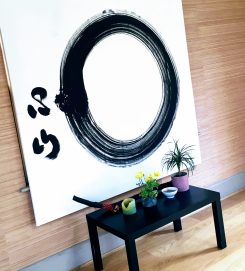
Case 1 of the Mumonkan goes like this:
A monk asked Joshu, “Has a dog the Buddha nature?”
Joshu replied, “Mu.”
Let me start by saying that koans are not riddles to be solved, but tools for practice. They’re short, sharp exchanges—often between teacher and student—designed not to be decoded with logic but to pierce through our habitual thinking. Koans cut across our mental patterns, dualistic reasoning, and the constant need to interpret or explain. They bring us into direct contact with what is already right here—reality as it is, unfiltered.
So, what do we make of this strange little interaction?
A monk comes with a question. He wants to know whether a dog has Buddha nature, and turns to someone he trusts—Master Joshu—for an answer. Instead of explaining or affirming doctrine, Joshu says only: “Mu.”
Now, mu in Japanese literally means “no” or “not.” But in this context, it isn’t a simple negation. Joshu is not denying that the dog has Buddha nature. He’s not interested in confirming or denying anything at all. Instead, mu functions like an explosion—a shock that breaks the frame of the question itself.
Rather than saying yes or no, Joshu points directly beyond the entire structure of dualistic thinking. Buddha nature or not? Right or wrong? Yes or no? The whole structure collapses with that one “Mu.”
When we work with this koan, we’re invited to do the same. To hold mu so completely, in body and mind, that all conceptual thinking falls away. And when that happens—when thinking collapses—something deeper might begin to show itself. Not as an answer, but as a different way of being. A different way of seeing.
Koans like this one are never finished. I’ve been practicing with Mu for some time, and every time I return to it, it brings up something new. It works on you. Or maybe it wears something away.
This particular koan might seem nonsensical. But within Zen practice, it makes perfect sense—if we stop trying to make sense of it. It’s a gate. A pressure point. A wedge that opens us up to something beyond the analytical mind.
The monk’s question comes from a traditional Buddhist teaching: all sentient beings possess Buddha nature. That includes dogs. So, the expected answer should be “yes.” But Joshu doesn’t affirm that. He offers mu. And in doing so, he interrupts the comfort of a doctrinal answer. He invites the monk into a direct, lived inquiry rather than another layer of belief.
Zen doesn’t care much for affirming or denying doctrines. It aims at seeing through the mental habits that separate us from reality. And I’ve noticed how much I, myself, want to know. To work things out. To build models and stories and explanations. And often, in doing that, I miss the only thing I can truly live: this moment.
I imagine there are people who spend lots of time talking endlessly about the past: what people said, why they said it, what they meant, what they think they meant. All these mental constructions. Why some people behave a certain way. Why other people are different. Anything but being present. And when I hear these type of dialogues, I think of mu—cutting through all that narrative, all that noise—and just being here.
Mu doesn’t need to be explained. It doesn’t need to be understood. There’s a saying: “There is only one big Mu in the entire universe.” How would you express that?
In practice, we are sometimes instructed to bring full attention to Mu during meditation. To sit with it. To breathe it. Each breath, each moment, becomes Mu. Over time, we feel the tension between our conceptual mind and the direct experience of the moment. And the aim is not to get an answer—but to let go of the need for one.
Eventually, something shifts. The tension itself becomes the doorway. Mu is no longer something we think about. We become one with it. We embody it. The question dissolves. The sense of separation dissolves. And in that, we meet what Joshu was pointing to all along.
There’s no longer the monk, the master, the dog—just Mu.
And then… life continues. The dog might bark. The monks will keep asking questions. And we get on with our lives. Nothing special. Just this moment. But we’re not lost in explanations anymore.
Personally, I experience Mu as a barrier I cannot bypass. I can’t think my way through it. I must live it. It wears away the self-centered mind. And so I try to carry it with me—in meditation, walking, cycling, eating, working. Because in the end, this koan isn’t about whether dogs have Buddha nature. It’s about whether I can see through the clouds that obscure my own.
I studied philosophy. I’ve always been someone who tries to figure things out. To analyze, explain, make sense. That’s not wrong. But Zen practice—and this koan in particular—has taken me somewhere else. It’s taken me out of thinking and into direct experience.
I’ve seen how much energy I can spend asking questions. Searching for answers. But Mu asks me to drop the question altogether. To see that any answer I come up with is based on my conditioning, my concepts—and none of those have fixed substance. Just like the teachings on emptiness remind us: no thought, no concept has a solid, unchanging core.
So Mu puts me right up against that wall. The wall of direct, raw, unfiltered experience. The only real experience I can be sure of is this one—right now.
That experience—unpolished, unprocessed—is beyond any dualism. Beyond right and wrong, like or dislike. It just is. And Mu brings me back to that reality. There’s nothing to explain. Nothing to solve. Just this. Just being it.
So yes—there is only one big Mu in the entire universe. And it’s alive, right now, through each one of us.
This koan keeps working on me. It reminds me to check: where is my mind now? Is it clouded by conceptual chatter? Am I trying to work something out that doesn’t need solving? Am I missing the only moment I have—this one?
Mu says: stop.
Be here.
Just this.
Nothing extra.
 Zen Mindfulness Cambridge Zenways Italia