This is the transcript of a talk I gave for the Zenways Sangha in July 2023
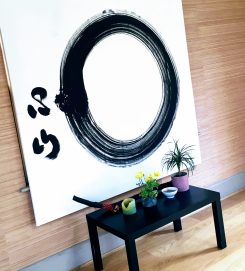
A couple of weeks ago I took part in the Japan trip with Zenways where the first part was dedicated to a 5 days meditation retreat, a Sesshin. That was in a beautiful place in the mountains just above a town called Ikoma. Just before the start of this Sesshin, we walked down the mountain to go to the local temple called Hōzan-ji, a temple dedicated to the Buddhist deity Fudō Myōō. There at the temple, as you can imagine, there were several statues of this deity, Fudō Myōō. I remember one in particular in which Fudō Myōō is depicted sitting on a stone with a rather menacing expression on his face, fierce flames behind his back and holding in one hand a sword and in the other something like a twisted rope. The term Fudo is an English translation of two Japanese characters. Fu translates as not and do translates as move. In other words, Fudo means not move, immovable, unshakable. In our practice that is the mental state one wants to aspire to have, a mental state of immovability, a mental state that is not captured, or moved, or dwells in thoughts, in memories, in ideas but rather a mental state that is totally unhindered awareness, open unobstructed awareness.
So, there in front of Fudo Myōō, I had the opportunity to set the intention for the my Sesshin and, we all know how setting intentions is the prime fuel in our practice. And, that applies to every moment of our day, in every moment of our practice, every time we decide to embrace the activity we are doing with that unshakable, unmovable mental state, simply embodying what we are doing without being captured, moved or dwelling in all the possible distracting mental formations which can take us away from what is really appearing in front of us. Not running away, not trying to change things, simply allowing what is arising to arise, without getting captured. That was to me the aspiration and the inspiration coming from this menacing look of Fudo Myōō.
Our practice is to explore this path of liberation and as Zen Buddhist practitioners, we have this eightfold path, the instructions the Buddha gave as the fourth part of the Four Noble Truths. The first noble truth taught us that to live out of our delusions is destined to be disappointing and that is known as the truth of suffering. In the second truth we learn that we are the cause of our own disappointment and that is the truth of the cause of suffering. In the third noble truth we see the hope to end our own suffering, the truth of the end of suffering. Finally, in the fourth noble truth the Buddha teaches that we can embark on this eightfold path, the path of liberation, to end suffering which is of course known as the truth of the path that leads to the end of suffering. Eight elements to practice with Understanding, Thought, Speech, Action, Livelihood, Effort, Mindfulness, Concentration, and I find, this is not a linear path. It doesn’t seem to go from right or skilful understanding to right or skilful concentration or meditation or effort and so on… However, I believe that there is something that needs to be seen in order to trust this path fully and embark on it wholeheartedly. That, perhaps is having right view. Clearly seeing suffering and what causes our suffering, first and second noble truths. I guess we need to develop some understanding on what the teaching in general wants to tell us, what it is aiming at, what it wants to show us. And, after a certain understanding of the teaching has been established, I believe that all the other “steps” or elements in the path can naturally follow, starting from developing skilful effort, mindfulness, concentration and so on.
But, going back to intention which I talked about just a few minutes ago, this is the element which energises our whole practice, that keeps us moving on this path. When a strong intention is established, moment to moment, that energy starts flowing into our activities, into skilful effort, skilful action, skilful speech, skilful understanding and so on. The intention of an unmovable mental state, the intention to embrace the present moment, the intention to becoming one with the action we are performing, being the action we are performing. And, I guess, with that we also start better understanding what a skilful effort is. Which effort we need, to cut through our mental delusions? Then skilful speech. What is skilful speech? What is unskilful speech?
Of course, I think that the eightfold path is quite self-explanatory. All we seem to need is to bring to mind that intention to be as skilful as we possibly can in all we do. And skilful to me means, that which doesn’t trigger suffering, that which doesn’t feed delusions. Can we learn to bring forward what is skilful and not to bring forward what is not skilful? We, of course need to develop mindfulness, making sure that we are aware of things. Aware of our actions, our speech, our thoughts and so on. And, the deepening of this quality of mindfulness can lead to insights, realisation, seeing into the real nature of things. And, that seeing into the real nature of things can now “energise” right or skilful view in a more direct way. Perhaps, we started to develop a right or a skilful view that was intellectual only, we understand the causes of our suffering mentally. But, through the development of these skills in the path we might gain a more direct experience, no longer an intellectual one only but also experiential. That more experiential understanding now is in turn feeding into more skilful intention, more skilful effort, more skilful concentration, more skilful mindfulness and so on.
So linear, not linear is perhaps a less important thing to establish when it comes to how to see and approach this path of liberation. Fudo Myōō is depicted as having a strong intention, for me he represents strong intention. So, what is arising in the present moment can be uncomfortable, we might not feel mentally prepared to sit unshakably with that and so we allow ourselves to escape that reality. And, that escape might help temporarily, it might bring a sense of relief, I can’t deny that, I have done it so many times that I know it works in that way. That can give us the impression of liberation, liberation from what seems to be unbearable. However, I guess we want something which is more than temporary, something which is more stable, something which is fully established. We want to develop a form of equanimity which is going to be valid in all of our life situations….. I recently heard Daizan saying that “the solution is in the problem” so, I guess, if we are not looking straight and honestly in what we perceive as being the problem, we are not going to find the “solution”, the end of suffering, liberation.
Fudo Myōō was holding a sword which I learned is called ‘ho-ken’, the sword that cuts through ignorance. So, in our practice, we sit, we set our intention and we simply don’t move, no matter what. Simply embodying sitting. Just establishing equanimity in the midst of mental formations. Developing skilful mindfulness, unhindered open awareness which is not enforcing a sense of me observing thoughts, memories, ideas and so on but clearly see that, thoughts, memories, ideas, fixations and so on arise together with this quality of mindfulness. All is arising together, one cannot arise without the other, it is one thing appearing and disappearing, naturally. No separation, no distinction, no good or bad, no right or wrong, just the arising of this moment as it is. Ho-ken, the sword that cuts through ignorance can support this alignment with things as they are without getting captured by our inner dialogues, our thoughts, our mental formations and so on.
Fudo Myōō supported my Sesshin, I did my best to establish equanimity when the jetlag triggered tiredness for example. The solution is in the “problem”, just becoming one with tiredness, no need to fight it. Simply acknowledge it and let it live through the body, fully. Be fully tired! The “problem” and the “solution” become one thing; it is one thing.
So, in a moment, we are going to do some walking and some sitting practice together. If we want to, it is our opportunity to just embody this Fudo element, not moving, a mental state of immovability, a mental state that is not captured, or moved, or dwells in thoughts, in memories, in ideas or fixations but rather a mental state that is simply unobstructed awareness. And we can use our sword of wisdom, to cut through whatever is trying to capture us. We don’t want to try to change things as they arise, we just want to become one with our mental formations, simply arise and pass with them unobstructed, no separation.
Thanks for listening.
 Zen Mindfulness Cambridge Zenways Italia