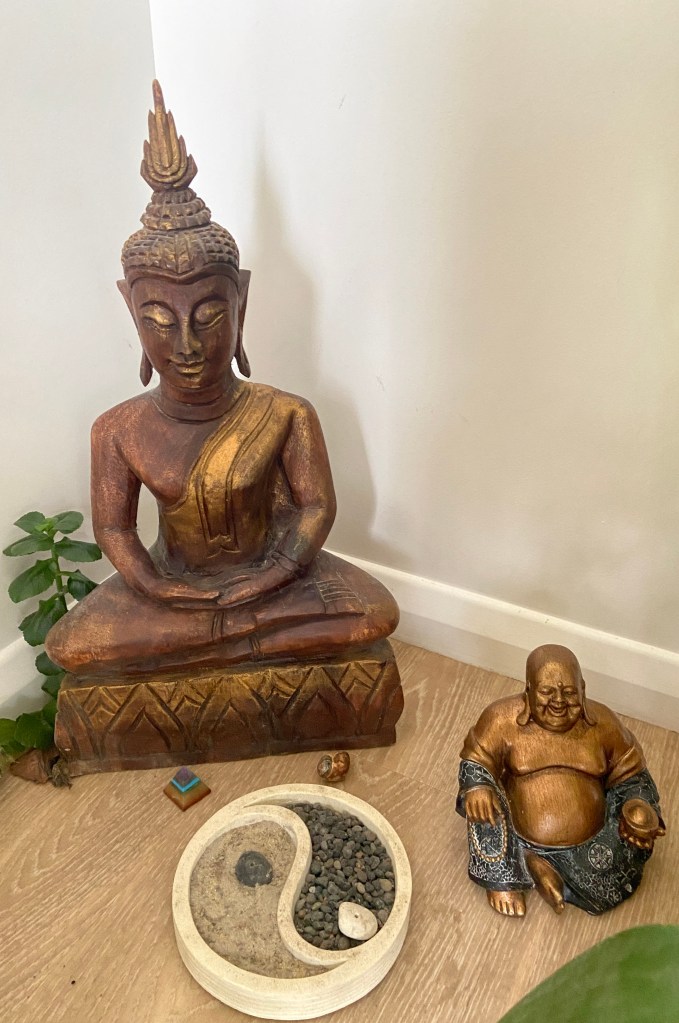
There is a statue of the Buddha in my living room. It is part of a small altar I set up to remind myself of my practice. A small statue of a laughing Buddha sits next to it, reminding me not to take myself too seriously. It’s a decoration, and it looks beautiful, but more than anything, it’s a statement I’ve made to myself about the meditation path I’ve committed to. The serenity that radiates from the Buddha statue and the joy in the laughing Buddha’s expression are deeply inspiring in my life.
When I joined Zenways, I knew very little about Buddhism. Now, three years later, I can’t really remember what I knew back then. Let me try. I knew that the Dalai Lama was the spiritual leader of Tibetan Buddhism. I’d always loved his smile—it felt different from the smiles of other religious leaders, at least in how I perceived it. I also knew that Buddhism was a peaceful religion, which appealed to me because I’ve never liked mindless confrontation. I knew it was popular in Asia, but honestly, I didn’t know of any Buddhist centers in Italy—now I know there are many.
One thing I did know: Italy’s most famous footballer, Roberto Baggio, is a Buddhist. I’d always admired Baggio as a player, but I never really looked into why he became a Buddhist. His career was marked by many injuries, but he always came back to play. I remember reading that meditation and Buddhism played a major role in his ability to return. Baggio’s perseverance reminds me of the Japanese proverb: “Nana korobi, ya oki”—fall down seven times, get up eight.
Through my own years of meditation, I’ve learned how to let failure, hardship, and difficulty into my life and practice, and how to keep going anyway—just get up and pick things up again. Resilience, perseverance, and discipline: these are qualities that meditation has nurtured in me.
When I first met my future wife, she told me she had a connection to Buddhism. She’s from Vietnam, which is traditionally a Buddhist country, and her grandfather was a Buddhist monk. Still, we never really spoke in depth about Buddhism. We talked about spirituality and meditation more broadly, but not Buddhism specifically. So when I joined Zenways, I was really starting from zero. But where else can a journey start, if not from zero?
After joining Zenways, I started reading books, watching videos, listening to Daizan’s talks, and gradually becoming more familiar with Buddhist practice and philosophy. What struck me immediately was that I didn’t have to believe in anything in particular. There was no god to worship, no strict rules to follow. I alone would be responsible for my practice and my way of living. No confession, no prayers for forgiveness, no reliance on someone else to go to heaven or hell. I was doing this on my own.
After a few months, I took the Buddhist precepts—but I’ll write about that another time. The contrast with Catholicism, the religion I grew up with, was striking. Catholicism directs your attention outward, toward God. Buddhism points inward, toward the self. “Turn the light and make it shine inward”—I’ve heard that instruction more than once. Learn about yourself, and see whether that learning can make you a better, more helpful human being.
Buddhism isn’t a religion in the conventional sense. It’s more of an exploration into the human condition—especially the mind. It’s a way to look into what conditions our actions, reactions, and behaviors. Once we begin to see what shapes us, we can start working to live in healthier, more peaceful ways.
Personally, I’ve come to understand things I never questioned before—why I avoid certain situations, why I carry certain prejudices, why I get nervous or angry. Buddhism, for me, is a way to look clearly at these internal patterns and see how they can be transformed—not just for my own benefit, but for everyone’s.
My life has become an experiment. Everything is something to explore. Life has become a kind of laboratory in which I try to discover the best possible version of myself. But how does this exploration begin?
It begins with the Buddha’s first teaching: life is suffering. That sounds harsh. Naturally, I wanted to understand what he meant. After all, I consider my life a happy one—I have everything I need for a good, satisfying life. So what is this suffering?
To me, the Buddha was pointing to the tension between how life really is and how we want it to be. Often, I catch myself in thoughts, perceptions, and ideas that wish things were different. For instance, I might think about someone, create a mental story, and then act or react based on that story. Now, whenever I see that person, I experience discomfort—not because of them, but because of the narrative I’ve created. I want them to be different, speak differently, behave differently. And that desire—that gap between reality and my expectations—is the root of suffering.
That’s just one example. This kind of dissatisfaction can come from anywhere: work, health, relationships, even how we see ourselves. We can easily end up fighting reality itself. But the Buddha says there’s a way out.
He offers what I like to call friendly advice—guidance that helps us develop qualities to reduce or even eliminate suffering. We can begin to see, with effort, what a healthier relationship with reality looks like. For me, the mental struggle to make things different has become optional. I now see that it’s my responsibility to make that shift.
The Buddha’s first suggestion is to see clearly—really clearly—not through the filter of our mental projections. He encourages us to observe how our mind distorts reality. Just spend a few honest minutes watching your thoughts, and you’ll notice the chaos. The “monkey mind,” as they say—it jumps from one thought to another without rest.
So the Buddha invites us to develop mindfulness. Can we observe our thoughts without getting pulled in? If so, we begin to see that thoughts are impermanent. They come and go. We start to see where our problems lie. Normally, we react too quickly, driven by thoughts and emotions. But we can learn to slow down, to observe first, and only then respond.
That’s the first big lesson I’ve taken from the Buddha: slow down. Observe. Learn from every situation. What emotions are arising? What thoughts? What instincts? Can I respond in a way that reduces suffering rather than adding to it? Every moment becomes a teaching. Every interaction becomes a mirror.
From there, we can ask: How can I speak more skillfully? What kind of work reduces rather than creates suffering? How can I use my energy more wisely? How can I aim to be a kinder, wiser person?

The Buddha invites us to take responsibility for understanding our suffering—and to follow his guidance for ending it.
It takes practice. It takes time, patience, determination, and commitment. You have to deal with your own stuff—no one can do it for you. That can be hard. But Buddhism is also an opportunity. An opportunity to unearth the truest version of ourselves—the Self buried under layers of conditioning and habit. The practice is a way back to that forgotten Self. That Self hasn’t gone anywhere. We’ve just grown used to operating from the ego-driven self, the one that makes us and others suffer.
Buddhism invites us to reverse that habit and return to our original nature. With practice, we begin to act from that place again.

Every time I walk through my living room, I look at the Buddha’s calm expression and the laughing Buddha’s playful face. They remind me to stay grounded, to be patient, to be disciplined in my practice—and to always, always remember to smile.
 Zen Mindfulness Cambridge Zenways Italia