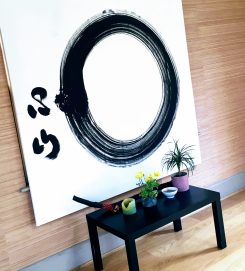
In 2019 I came across a community of Zen practitioners in London called Zenways.
Zenways can be translated as “the ways of Zen.”
Since then, I have studied and practised Zen under the guidance of Julian Daizan Skinner, taking part, again under his guidance, in a training programme to become a Zen teacher.
At the beginning of May 2023, Daizan granted me permission to teach through Dharma Transmission, recognising me as a teacher in the Rinzai Zen lineage.
“Zen” means “meditation” in Japanese, and the practice of meditation is the heart of this approach.
The ultimate aim of Zen practice is to discover who we truly are — not as an idea, not as a concept to be discussed, but as a direct experience, undeniable and not in need of anyone’s validation.
Through this discipline we seek a source of happiness that does not depend on external factors: something no one can give us or take away.
A happiness that is not based on our successes or failures, our possessions or recognitions, but that arises from a much deeper place.
As we grow up, we almost automatically become used to living in a world of opposites: me/you, good/bad, success/failure, right/wrong, subject/object, life/death.
This world exists, without doubt. But it is only a partial and subjective perspective; it is not the whole picture.
Zen practice does not ask us to lose the ability to live in the dualistic world — the one in which we act every day, with its distinctions, choices, and consequences. That would be tragic.
Rather, it invites us to develop the ability to operate from another perspective as well: the non-dual one, which opens only in the present moment, in the here and now.
From this non-dual place, problems disappear. There is no success or failure, no right or wrong: there is only this moment.
Zen practice trains us precisely in this: learning to inhabit both levels — the everyday, dual one, and the essential, non-dual one.
One could write books and talk for hours about all this.
But Zen is practice.
It is the willingness to practise with consistency and sincerity, in order to clearly experience how it is possible to act in the world, with all its complexities, while remaining anchored to a place within ourselves where there is no problem.
As with any other discipline, dedicating time is essential.
I have been riding a bicycle since I was five years old — or at least I think so (I am sure I am over fifty, but not one hundred percent sure I started pedalling at five!).
I know very well that there is a big difference between training a lot or a little, between practising regularly or only now and then.
I believe the same applies to playing an instrument, learning a craft, or acquiring a language.
The more time we dedicate, the more skilful we become.
And with meditation, with Zen practice, it is exactly the same.
This blog begins from here.
It is not an official place, not an institution.
It is simply the space where I share my experience.
Here I gather writings on Zen practice as I have lived it and continue to live it every day.
There are reflections born from formal practice, from silence, from retreats.
There are pieces in which Zen meets the bicycle, because for me riding has always been a way of practising — even when I did not know it was called that.
And there are stories of my life on a bike: falls, returns, enthusiasm, pauses, new beginnings.
This blog is simply my way of making sense of what I live:
on the cushion, on the road, and in the folds of everyday life.
 Zen Mindfulness Cambridge Zenways Italia