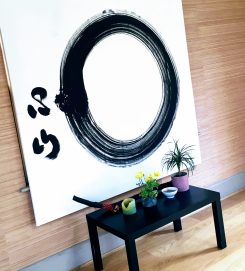
A very ordinary instruction in Zen is this: drop off delusive thoughts. I’ve heard it many times, and it seems to me one of the core elements of our practice.
But what are these delusive thoughts? And more generally—what are thoughts?
Reflecting on this dimension is essential. Through it, we give ourselves a chance to better understand our behaviours, our fears, our worries, our reactions, our emotions—and much more. But if we try to define a thought too tightly, we can easily become entangled in the very thing we want to understand. We get trapped in what we’re trying to be a little freer from.
So perhaps reflecting is fine—but only up to a point. We don’t want to get lost in the world of endless speculation. What really matters is not the theory, but the seeing: seeing clearly that we have an inner world—made up of thoughts, ideas, beliefs, memories, sensations, emotions—and this inner world influences how we act in the outer world.
This is not difficult to notice. And I believe it’s the very starting point of our practice: seeing the connection between our inner states and our outward actions.
Throughout life, we accumulate experiences. And those experiences leave a mark—a trace—in us. As we gather more and more of these traces, we also begin to be shaped and conditioned by them.
A past memory can trigger fear in a present situation. Someone we once met might have passed on an idea—voluntarily or not—that we’ve held onto ever since. The places we’ve lived, the cultures we’ve grown up in, the values we’ve absorbed… all these shape our sense of right and wrong, our beliefs, our identities.
Most of us end up developing solid, fixed ideas: about what we are, what’s acceptable, what’s not, what we believe, what we reject. Each person ends up with a unique mental wiring. Each one of us reacts, thinks, judges and navigates life through this wiring, this conditioned system.
And often, we hold on tightly to it all. Why? Because it becomes our identity. It becomes our anchor. Our compass. The structure we feel we need in order to function.
But for me, dropping off delusive thoughts is about becoming intimate with what is actually here, now. It’s about sharpening attention to this very moment, and letting go—at least temporarily—of the baggage I carry with me.
What do I really need in this moment?
What do I really know of this moment, beyond the direct experience of living it?
Could it be that our conditioned mental wiring—our inherited views and beliefs—actually limits our ability to experience this moment fully?
Is there another way to be in the world?
Sometimes we think we’re on the right path. That we’re progressing from point A to point B. That we’re understanding something. But is there really a path? Is there a point A, a point B?
What is it that we think we’re getting, or understanding?
Life is always changing. Always moving. Never fixed. And yet, we cling to the idea of something fixed: a beginning, an end, a self, another.
Where do these beliefs come from? Can we really rely on them?
Are my thoughts more true than yours? Are my beliefs somehow better, more right?
Do we even know what we really are?
Where does that idea come from? A thought? A belief? An identity? A name on a passport?
Our practice is to explore. To explore the possibility of stepping out of our limiting ideas and beliefs. To get them out of the way, not with violence or force, but gently—so we can meet directly what is here: this moment.
The rest—no matter how nice, beautiful, convincing—might just be… a delusive thought.
Enjoy exploring the possibility of grounding yourself in what is always changing, always alive, never fixed.
How are you experiencing this moment—before your mental sphere jumps in?
We can spend a lifetime analysing all of this. But I feel that won’t give us the direct experience of what’s real.
So… have fun.
 Zen Mindfulness Cambridge Zenways Italia