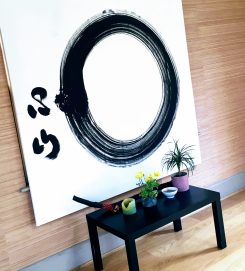
This is the rough script of a talk I gave in January
Tonight, I want to share how I’ve experienced this beginning of the year, and how I’ve been practicing with it.
January always feels like this slow, low-energy period for me. Something that isn’t yet ready to come fully alive. A time that feels quiet and a little lethargic. How do you normally feel in January?
On top of that, for the first few weeks of this new year, I’ve been missing my bike, which has been away for some essential repairs.
I’ve realised how much I rely on cycling. I’m addicted, in a way, to the natural dopamine it produces — the energy, the clarity, the rush of being outdoors, moving, feeling the wind, the connection with nature. All these things which make my days feel in a certain pleasurable way. Cycling gives me a kind of constant high, a sense of fullness and aliveness.
So, the combination of this familiar January pattern and the absence of my bike made this period particularly noticeable.
Nothing dramatic, no big crisis.
But something subtle and persistent: a sense of lack, a quiet dissatisfaction, a body and mind that felt slightly flat and, at the same time, slightly restless.
When things feel smooth, I guess that life is less noticeable. I get up, I get on with my many routines and go to bed, smooth, flowing with, somehow, predictable days. When things feel a little bit itchy, uncomfortable, things become more noticeable, mind and body become a very fertile field to put into practice what we are learning through this Zen practice. So, I get also to notice more clearly how I practice with this. How I meet it, how I stay with it, how I allow it to be here without trying to chase it away. Or getting distracted at all cost.
When I notice this sense of dissatisfaction or lack of energy, I like to remind myself of the fundamentals of the Buddha’s teaching.
The First Noble Truth is right here: there is dukkha, suffering.
Not dramatic suffering, but this quiet dissatisfaction, this sense that something isn’t quite right.
And the practice begins simply by recognising it.
This is what it feels like right now.
Nothing has gone wrong.
This is how conditions are coming together in this moment.
Then the Second Noble Truth becomes visible.
The mind resists. It wants things to be different.
I’m not just tired — I want NOT to be tired.
I’m not just low on energy — I want MORE energy.
The discomfort isn’t only in the low energy itself.
It’s in the craving for a different experience.
Without the bike, without that reliable source of stimulation and clarity, the mind starts looking for a substitute.
What else can I do? How can I get back to that feeling? How can I push through this flatness?
And then, when I don’t follow that impulse, the Third Noble Truth shows itself.
When I stop trying to fix the experience, even just a little, something changes.
The low energy is still there.
January is still January.
But the suffering around it softens.
I begin to see that the problem isn’t the dullness or the lack of energy.
The problem is the resistance to it.
The belief that this moment should feel different from how it does.
The Fourth Noble Truth, in this moment, is very ordinary.
It’s the practice of presence.
Staying with what is.
Feeling low energy as low energy.
Feeling restlessness as restlessness.
Without adding a story that something is wrong.
This doesn’t mean doing nothing.
It doesn’t mean ignoring what’s nourishing or what we think could be helpful.
It means meeting this moment as it is, without fighting it.
And, as I practice in this way, I notice something else.
There’s a quiet reduction in that sense of dissatisfaction.
Not a high, not a burst of joy — but at least a sense of okay-ness.
A sense that this moment, even with its flatness, is workable, it is manageable. Noticing my body functions and seeing that all is still working ok. It is the mind and the attachement we might have to it, the issue, what creates suffering.
And….I’m also reminded of impermanence. This January heaviness will change on its own.
Energy will return. The bike will come back. Nothing needs to be forced. Flowing with things the way they are means allowing, means becoming a bit more patient, it means noticing how much control our mind can have on the way we experience things and how we don’t need to be controlled by it. We can rest in the neutral. This is practising meditation. The practice of allowing things to be as they are.
The practice of not believing that something is wrong just because this is how I feel or what our mind is telling us.
There is also a teaching from Eno, the Sixth Ancestor of Zen in China, who really emphasized direct experience over ideas
He says:
“Without thinking of good or evil, at this very moment, what is your original face?” What is your true nature? What or who are we really?
This is not as a philosophical question, but an invitation.
Before I decide that low energy is bad. Before “low energy” becomes a problem. Before I label Low energy as bad.
Or, Before I decide that clarity or excitement or cycling is good. Before “high energy” becomes something to cling to. Before I label Dopamine, cycling, clarity as good.
Or, Before January needs to be different. Before January becomes a problem.
What is actually here, right now?
Yes, Low energy, perhaps.
Flatness.
Restlessness.
But,… nothing wrong with any of that.
So, this period — the low energy, the missing bike, the subtle dissatisfaction — isn’t an obstacle to practice. It is the practice.
And what is the teaching I take from it? Well, it is very simple:
I don’t need to fix the dullness, the lack, or the low energy.
I can notice it, stay with it, and see it clearly. Letting January be January.
How does it feel to have low energy? How can I explore that in my practice?
And maybe this is something we can take with us.
It is fine to feel low. It is fine to feel down at times. It is fine to feel lethargic, unmotivated, or flat.
These states are not a mistake, and they are not a sign that our practice is failing.
They are part of the natural rhythm of being human.
When life feels like this, it is not asking us to fix it. It is rather asking us to meet it.
This is actually a very good moment for practice.
Because when things are noticeable — when they don’t flow smoothly — we can see more clearly how the mind reacts.
We can see the impulses to escape, to push, to replace, to improve, to be distracted.
And instead of giving in to those impulses, we can learn something else.
We can pause.
We can feel what is here.
We can let low energy be low energy.
Not judging it.
Not turning it into a problem.
Not believing that something is wrong with us.
This is how we develop a different kind of freedom, I guess.
Not by feeling good all the time, but by not being controlled by every mental impulse that arises.
So when energy is low, maybe the invitation is very simple:
notice it, stay with it, and see how it actually feels in the body and the mind.
Without changing anything.
That, too, is practice.
And this is where sitting meditation becomes so important.
Because sitting is exactly the place where we can explore this teaching for ourselves.
Not as an idea, not as something to understand, but as something to experience directly.
When we sit, there is nothing to fix.
No bike to ride.
No energy level to optimise.
Just this body, this breath, this mind, exactly as it is.
If energy is low, we let low energy be here.
If the mind is restless, we let restlessness be here.
Without calling it good or bad.
Without trying to move away from it. Just knowing, acknowledging it is there
This is Eno’s question again.
Without thinking of good or evil, what is here right now?
Sitting gives us the space to see how quickly the mind wants something different —
and also gives us the space to NOT follow that impulse.
So as we go into the next periods of walking and sitting meditation, maybe there is nothing special to do.
No state to reach.
Just an invitation to sit with January as it is.
To sit with low energy, if that’s what is here.
To let experiences unfold without always having this impulse to interfere and becoming restless about that.
for a blog post, title?
 Zen Mindfulness Cambridge Zenways Italia